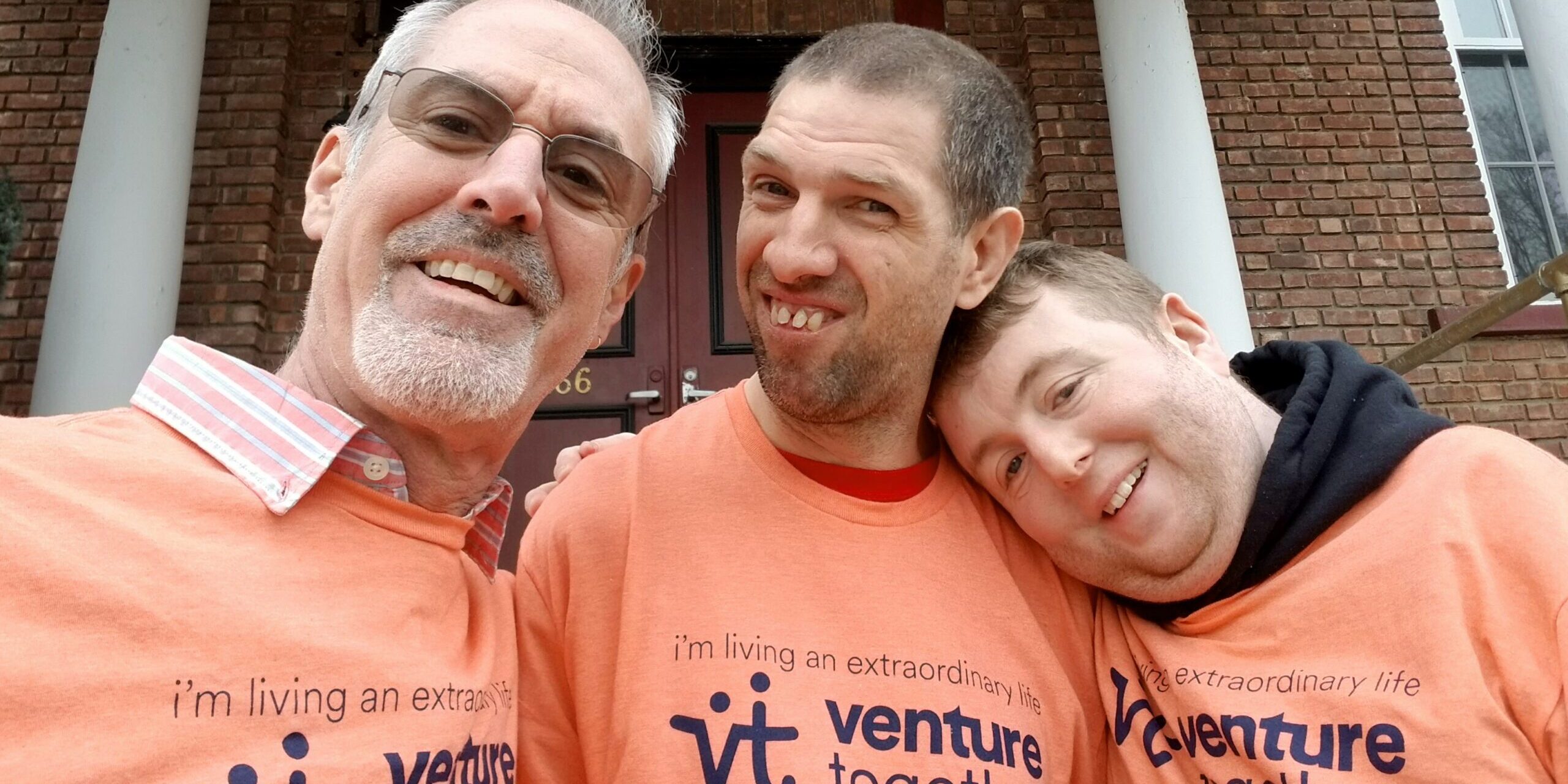
Michael Killeen, Director of Venture Academy, has spent four decades proving that when systems are built around people—not institutions—extraordinary things happen.
Michael Killeen didn’t plan on a career in disability services. He came to Venture as a Camp Venture lifeguard. “I never went to camp as a kid,” he laughs. “But it was fun.”
That was around 1980. Today, Michael is the Director of Venture Academy, Venture Together’s day habilitation program in Rockland County, NY—and he’s still showing up with the same conviction that first drew him to this work: that people with intellectual and developmental disabilities are capable of far more than the world gives them credit for.
A System Built Around Barriers—and a Few People Who Refused to Accept Them
Michael began his career at the tail-end of New York’s institutional era. As the last lifeguard at Letchworth Village, the infamous state institution in Stony Point, he watched as it closed its doors, and its residents fanned out to community agencies like Venture Together.
“I walked into the wrong door at Letchworth and ended up in a ward. I knew right away: no wonder they’re closing these things up.”
What he witnessed wasn’t just poor care—it was an institutional system designed around control rather than people. For decades, individuals had little ownership over their belongings, their choices, or even how they spent their days.
When Venture Together began welcoming those residents into community homes, there was no playbook. Michael and his colleagues had to invent what “family-style” living actually meant—together.
“There was no ‘this is how we always did it.’ So we asked: what do we want this to look like? What experiences do we want our individuals to have?”
That question, radical at the time, has guided his work ever since.
The Invisible Barrier
Ask Michael about the barriers people with intellectual and developmental disabilities face, and he’ll tell you the most persistent ones aren’t physical. They’re rooted in assumption: the quiet, often unconscious belief that an individual isn’t capable, before anyone has really found out.
“People have been doing things for them for so long, they’ve figured that’s just how it’s going to be. But our job is to teach them to do things for themselves.”
It’s a challenge that runs through every part of the system—schools, families, care settings—and one that Michael has spent decades trying to address through a simple practice: meeting people where they are, then gently raising the bar. Not doing things for people, but creating the conditions for them to grow.
The philosophy he returns to again and again is “gentle teaching”, a framework built around incremental steps, consistent presence, and modeling the behavior you want to see. “If you want them to be cheerful, you have to be cheerful. If you want them to be respectful, you have to be respectful. Our individuals are watching all the time.”
Breaking down the barrier of low expectation, he’ll tell you, starts with standing alongside an individual and deciding to believe in what’s possible before there’s any proof.
A Trip to Kohl’s, and a Lesson About Dignity
One story captures the stakes of that philosophy in full measure.
Michael once took a participant, a man who’d grown up with his family and had most decisions made for him, on a one-on-one shopping trip to Kohl’s. During the trip, the participant picked out his own clothes, carried his own money, and paid at the register himself. When the cashier complimented his choices, Michael watched something shift.
“I could see how proud he was. He got home and told everyone, ‘Look what I got. I got this. I got that.’”
It sounds simple. But for an individual who had spent a lifetime having choices made for him, walking into a store and trusting his own judgment was anything but. That moment of pride in himself, his accomplishment, and his growing independence was exactly what Venture Together works to create every day.
Michael knows those moments are tenuous. Independence isn’t built in a single trip to a store, but rather through repetition and the dedication of people who continuously show up with the belief of “you can do this”. When the systems around a person reinforce that message, growth blossoms. However, when those systems pull back, even unintentionally, the confidence that took so long to build can quietly erode.
Therein lies the largest barrier: not the absence of opportunity, but the absence of sustained opportunity. Breaking that barrier requires everyone in an individual’s life to be on the same mission of growth.
What Forty Years Teaches You About Ability
Michael speaks often about the “dignity of risk”, a concept from his early training that he’s never stopped practicing. It means letting people try things, even when they might fail, because the alternative is worse.
“If you don’t let them try, they lose that ability. People have been doing things for them for so long, they’ve figured that’s just how it’s going to be.”
He recalls rolling a man in a wheelchair through a sprinkler at the Letchworth pool, a resident who’d been heavily medicated, lacking meaningful engagement, and written off by staff as unresponsive. In the fun of the sprinklers, the individual came to life, laughing and responding to the moment. Minutes later, as Michael helped dry him off, he leaned over and whispered:
“Do you think the doctors can fix me?”
In that moment, Michael saw, “There was an awareness not only of self, but awareness of condition. This was a person. And we almost missed him entirely.”
This summer, he watched his participants from Venture Academy go water skiing:
“I saw my group, and I couldn’t believe it. They are capable of a whole lot more than we give them credit for.”
Breaking Barriers, One Morning at a Time
Every morning at Venture Academy, Michael stands in front of a whiteboard covered in names—seventeen participants at his day program, each with their own strengths, struggles, preferences, and needs. He moves names around like puzzle pieces, trying to build a day that works for everyone.
“I woke up this morning, and the first thing that came to my mind was: what can I do at the Academy to make Brian’s day better?”
While a majority of his work is largely unseen, it is, in Michael’s words, never boring or unimportant.
The barriers that people with intellectual and developmental disabilities face aren’t only structural. For them, the small moments and decisions that build barriers matter: the assumption that an individual “can’t”, choices offered without consideration for them, or a caretaker on their phone while they seek connection.
Breaking those barriers requires someone who shows up with full dedication and heart every single day. For forty-plus years, that’s been Michael Killeen.
_____________
Venture Together’s Breaking Barriers campaign runs all of March in recognition of Developmental Disabilities Awareness Month.
Every story we share, every dollar donated, and every new connection made helps us build a more inclusive Rockland County—one where people with intellectual and developmental disabilities have the support, opportunity, and community they deserve.